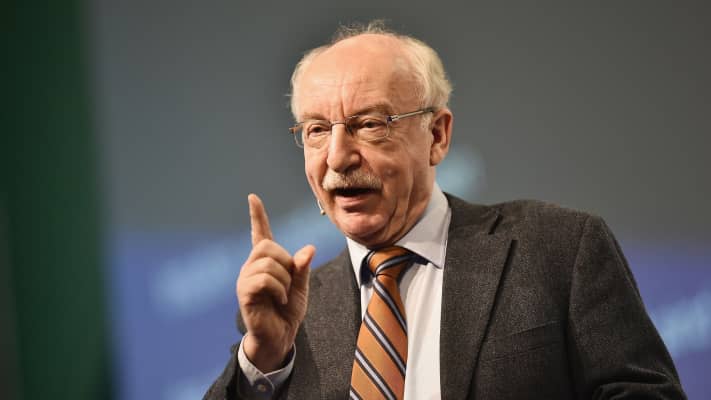
Gerd Gigerenzer

| Use attributes for filter ! | |
| Gender | Male |
|---|---|
| Age | 79 |
| Date of birth | September 3,1947 |
| Zodiac sign | Virgo |
| Born | Wallersdorf |
| Germany | |
| Spouse | Lorraine Daston |
| Alma mater | Ludwig Maximilian University of Munich |
| Children | Thalia Gigerenzer |
| Albums | Risiko - Wie man die richtigen Entscheidungen trifft (Ungekürzt) |
| Job | Psychologist |
| Author | |
| Affiliations | Max Planck Institute For Human Development |
| Education | Ludwig Maximilian University of Munich |
| Interests | Decision Making |
| Heuristics | |
| Bounded Rationality | |
| Risk Communication | |
| Publications | scholar.google.com |
| Notable student | Daniel Goldstein |
| Date of Reg. | |
| Date of Upd. | |
| ID | 460682 |
Calculated Risks: How to Know When Numbers Deceive You
Reckoning with Risk: Learning to Live with Uncertainty
Rationality for Mortals
The Empire of Chance: How Probability Changed Science and Everyday Life
Adaptive Thinking
Cognition as intuitive statistics
Simply Rational: Decision Making in the Real World
Ecological Rationality: Intelligence in the World
Messung und Modellbildung in der Psychologie
Gut Feelings: The Intelligence of the Unconscious
Risk Savvy: How to Make Good Decisions
Simple heuristics that make us smart
How to Stay Smart in a Smart World: Why Human Intelligence Still Beats Algorithms
Reckoning with Risk: Learning to Live with Uncertainty
Rationality for Mortals
The Empire of Chance: How Probability Changed Science and Everyday Life
Adaptive Thinking
Cognition as intuitive statistics
Simply Rational: Decision Making in the Real World
Ecological Rationality: Intelligence in the World
Messung und Modellbildung in der Psychologie
Gut Feelings: The Intelligence of the Unconscious
Risk Savvy: How to Make Good Decisions
Simple heuristics that make us smart
How to Stay Smart in a Smart World: Why Human Intelligence Still Beats Algorithms
Gerd Gigerenzer Life story
Gerd Gigerenzer is a German psychologist who has studied the use of bounded rationality and heuristics in decision making.
Gerd Gigerenzer Photos